Free tool
Generate your realistic study plan
Set target score, timeline, and weekly hours. Get a clean plan with milestones and next actions without creating an account first.
Built for consistency, not overwhelming schedules.You can revise your plan at any time. Next source review due September 4, 2026.
Plan builder
Build a usable MCAT plan
Required inputs
Adjust the constraints that drive timeline, workload, and mode.
Learning mode
Recommended: structuredGenerated plan
Steady Growth
Target
511–515
score band
Timeline
17 weeks
from 2026-11
Hours/wk
18
306 total hours
Cadence
5 sessions
216 min/session
Milestones
4 checkpoints
final week 17
Mode
Structured
recommended: structured
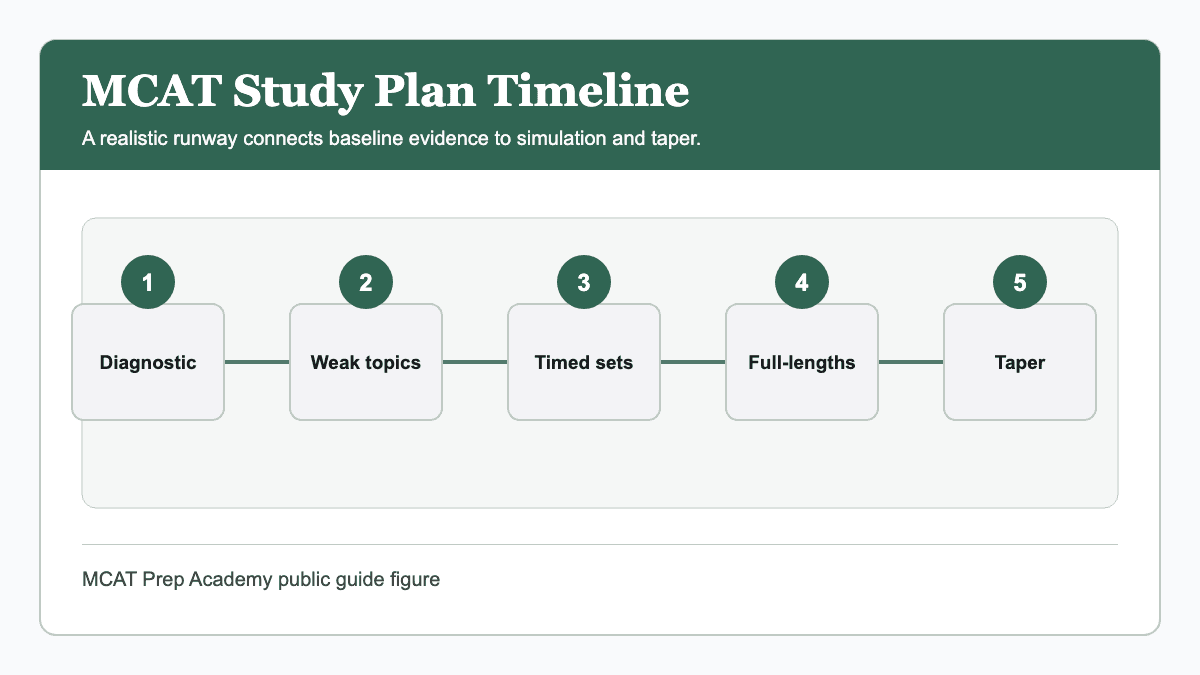
Maintain a repeating rhythm: learn → practice → review → adapt.
Next actions
Next checkpoint: 24 hours after this plan is generated
Week-by-week plan
Steady mode: repeatable rhythm with enough review bandwidth to keep retention from drifting.
Efficiency
82/100
Balanced pace
Foundation + concept wiring
6 weeks / 108hLearn + consolidate high-yield pathways using short lessons and 1–2 focused quizzes (18 h/wk total).
- Build durable concept map and flashcard seeds
- Clear initial diagnostic by topic block
- Keep notes compact for future review
Targeted drilling
6 weeks / 92hClose weak concepts fast with topic drills, flashcards, and review loops. Budget 5 h/wk for active recall work.
- Run weakness-first sessions at each section transition
- Practice retrieval 2–3 times per week
- Raise first-attempt accuracy before increasing pace
Practice conditioning
4 weeks / 76hBuild timing, passage stamina, and error analysis habits with full-length cadence + targeted post-mortems.
- Take full-length or section exams on a strict cadence
- Review every missed question using AI tutor notes
- Track speed drift, not just accuracy
Polish + official-style simulation
1 week / 30hProtect your score: last-leg question mix, CARS speed, and final-risk remediation within error logs.
- Lock in final formula patterns and passage traps
- Keep momentum through low-volume but high-fidelity drills
- Finalize rest-day and sleep protection plan
Milestones
Week 3: Phase 1 checkpoint
Foundational recall reaches baseline + baseline quiz pass
Week 9: Weakness bandwidth built by week 9
Weak topic tags are being remediated 2+ sessions/week
Week 13: Exam rhythm stabilized by week 13
Full-length cadence is consistent and review quality is stable
Week 17: Score-lock readiness by week 17
Ready for score-pace simulation and final risk control
First 24h
Set up 5 study sessions this week at about 216 minutes each.
Start with foundation + concept wiring and complete its top priority objective first.
Keep one 24-hour review checkpoint after each session so retention is reinforced before moving on.
If you miss pace on Day 2 or 3, pause for 20–30 minutes and do your highest-priority block before restarting your plan.
Effort signal
Balanced runway: this is optimized for consistency while still allowing speed-up on weak topics during the week.
Focus window: 154 min/day
Share text
My MCAT plan Target score: 511–515 Study budget: 18h/week Timeline: 17 weeks Target month: 2026-11 Study mode: STRUCTURED
Official calendar and timing context
The plan uses your target month or timeline as a planning constraint, not as an official registration source. Before you lock a test date, verify available seats, scheduling deadlines, and score release dates with AAMC. Last reviewed July 18, 2026.
Ready for guided execution?
This tool generates account-ready inputs. Signed-in students can save the plan; new students carry the same settings into signup and onboarding.
Back to builder