Answer first
What is the best way to improve MCAT CARS?
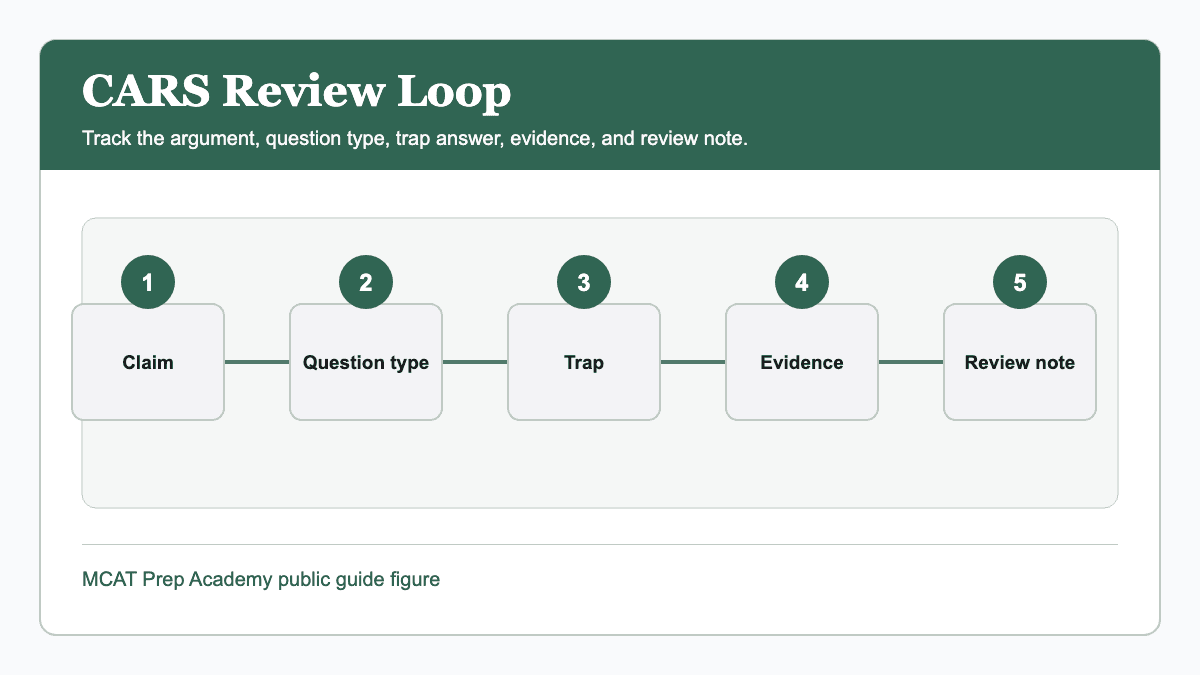
The best CARS improvement plan trains timing, argument structure, and review discipline together. Reading more slowly is not enough, and doing random passages without review usually plateaus. Start by treating each passage as an argument: identify the author position, paragraph function, tone, and contrast words. Then answer questions by asking what the passage supports rather than what sounds true outside the passage. After the set, classify every miss as main idea, inference, detail, tone, function, or trap-answer selection. Daily practice matters because CARS is less cram-friendly than content-heavy sections. A useful schedule is one timed passage most days early, two to three passages as timing improves, and full 90-minute sections during the final stretch.
Practical examples
Wrong scope miss
Mark the answer as outside knowledge, write the passage-supported claim, and drill two questions from the same type the next day.
Author attitude miss
Name the author's stance in one sentence before reviewing why the credited answer matched that stance.
Daily CARS routine
Read for the author's claim, mark contrast pivots, answer under a time cap, then write one review note for every miss. The note should name why the wrong answer tempted you.
Trap-answer review
Track extreme wording, reversed author position, outside knowledge, partial match, wrong scope, and correct-but-wrong-question choices. Patterns are more useful than raw passage counts.
Methodology and limits
Review rule
CARS review should classify the miss, the trap, and the passage evidence. Passage count alone is not the success metric.
Sources and review notes
Last reviewed July 18, 2026. Timing and admissions claims should be verified against the official source before a student makes a test date or application decision.