Answer first
What does an MCAT diagnostic score mean?
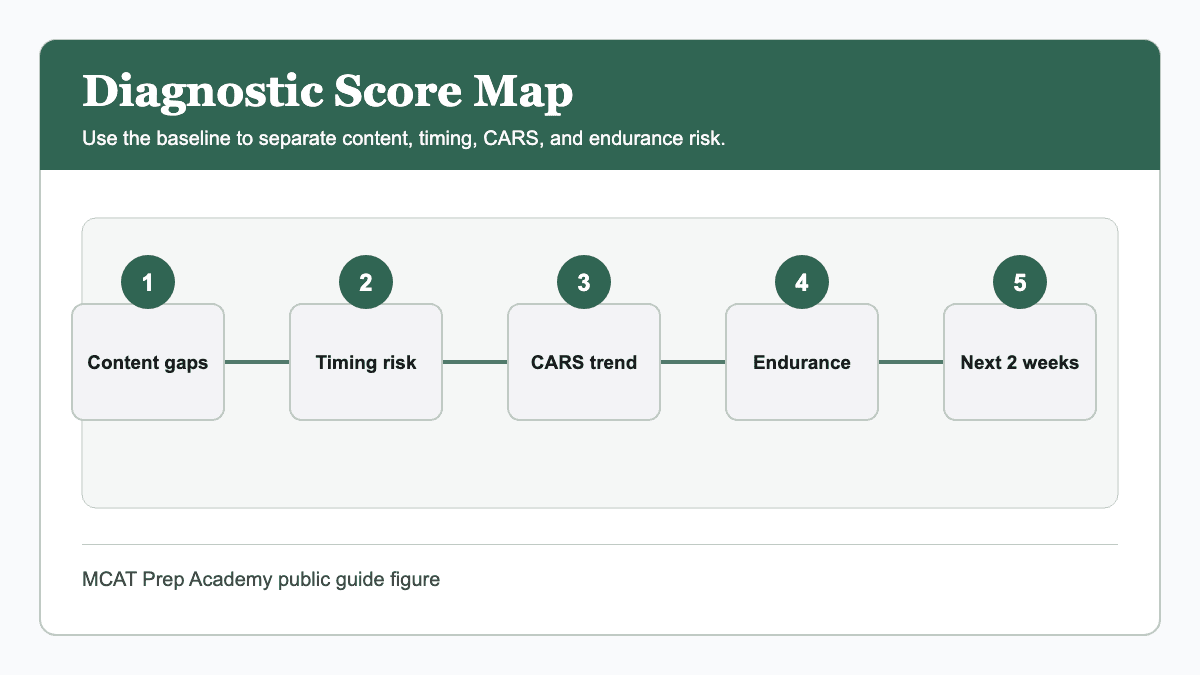
An MCAT diagnostic score is a baseline, not a prediction of the final score. Its job is to show the starting distribution of strengths, weaknesses, pacing, and endurance before a student has built a full study system. A low diagnostic can still lead to a competitive score if the misses are content gaps and the timeline is long enough. A high diagnostic can still be risky if timing, CARS consistency, or full-length stamina is unstable. The right response is to separate section score, question type, and error reason. Content misses need targeted review and spaced recall. Passage-reasoning misses need timed practice and explanation review. Careless or fatigue errors need test-condition simulation. The diagnostic becomes useful only when it changes the next two weeks of work.
Practical examples
Low content baseline
If most misses are concept gaps, extend the content runway and delay heavy full-length frequency until review notes start converting to accuracy.
Uneven section profile
If one section carries the total, protect it with light review and spend the next two weeks on the highest-repeat weak section.
Score-band response
Below target by 12 or more points usually calls for a longer runway. Within 6 to 10 points can often improve through targeted practice. Near target requires simulation discipline and careful review.
What not to infer
Do not treat one diagnostic as proof that a school list is impossible or that a retake is necessary. Use multiple timed checkpoints before making high-stakes timing decisions.
Methodology and limits
Interpretation rule
The diagnostic is a planning input, not an admissions prediction. It should classify misses before it changes a test date or school list.
Sources and review notes
Last reviewed July 18, 2026. Timing and admissions claims should be verified against the official source before a student makes a test date or application decision.