High-yield review
Tie cell signaling, genetics, and physiology misses back to what changed in the passage experiment.
MCAT subject hub
Public biology overview for cell biology, physiology, genetics, and experimental reasoning.
Biology questions reward mechanism tracking: what changes, where it changes, and how the passage measures it. Use this page as a public overview. Full lesson flows, quizzes, and account progress stay inside the private app, while these edited guide links give crawlers and students enough context to understand the topic area before signup.
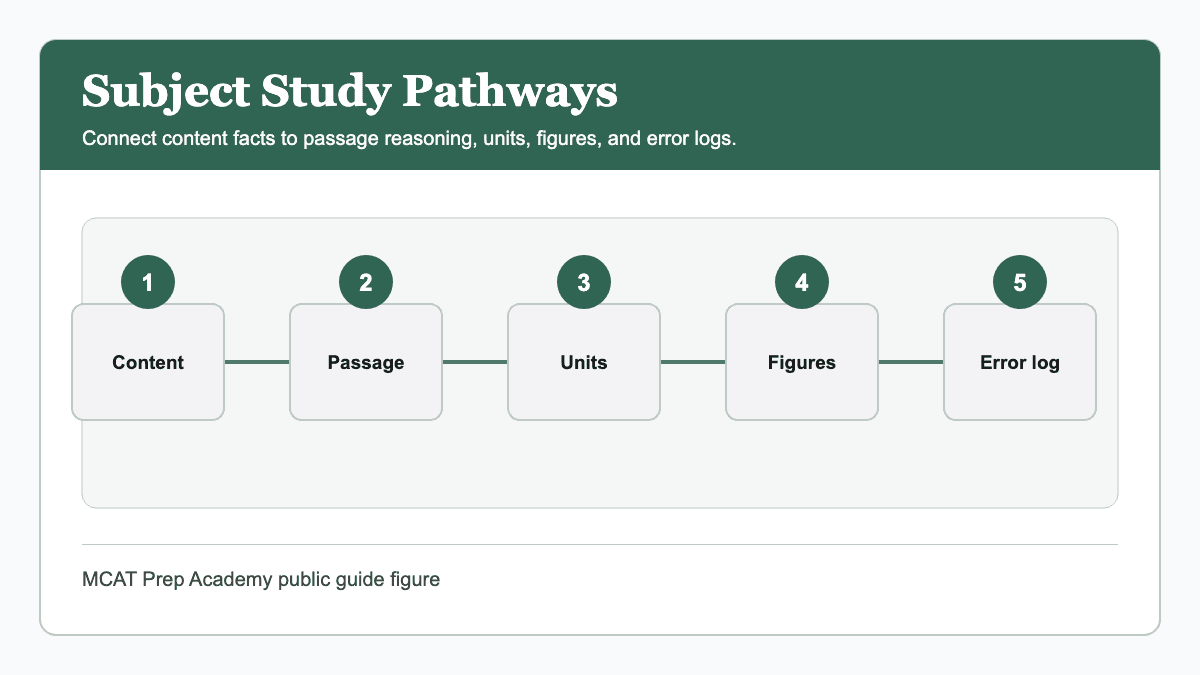
Tie cell signaling, genetics, and physiology misses back to what changed in the passage experiment.
Use official AAMC content outlines for scope, then use passage misses to decide which mechanisms need deeper review.
A working tour of cell theory, the prokaryote-eukaryote split, the endosymbiotic origin of mitochondria, and the acellular agents that bend the rules.
8 min read
A first-principles walkthrough of how the plasma membrane decides what crosses, what gets pumped, and what gets swallowed whole.
9 min read
How a protein travels from the rough ER through the Golgi to its final destination via vesicle trafficking, glycosylation, and address tags.
9 min read
Mitochondrial structure, the TCA cycle, the electron transport chain, and chemiosmotic ATP synthesis explained as one connected energy pipeline for the MCAT.
8 min read
How the three cytoskeletal filaments build cell architecture and how kinesin, dynein, and myosin convert ATP into directed mechanical work.
8 min read
A mechanism-first contrast of prokaryotic and eukaryotic cells covering compartmentalization, genome architecture, ribosomes, and the endosymbiotic origin story that ties it all together.
9 min read
A mechanism-first walkthrough of how DNA, RNA, and retroviral genomes commandeer host machinery to replicate, with the test-day distinctions students miss.
9 min read
Five junction types and the protein mesh outside the cell — what they do, why test writers love them, and how to keep them straight.
9 min read