High-yield review
Review equilibrium, acids and bases, electrochemistry, and thermodynamics through units and proportional reasoning.
MCAT subject hub
Public general chemistry overview for equilibrium, acids/bases, electrochemistry, kinetics, and thermodynamics.
General chemistry improves when formulas are tied to units, assumptions, and passage triggers. Use this page as a public overview. Full lesson flows, quizzes, and account progress stay inside the private app, while these edited guide links give crawlers and students enough context to understand the topic area before signup.
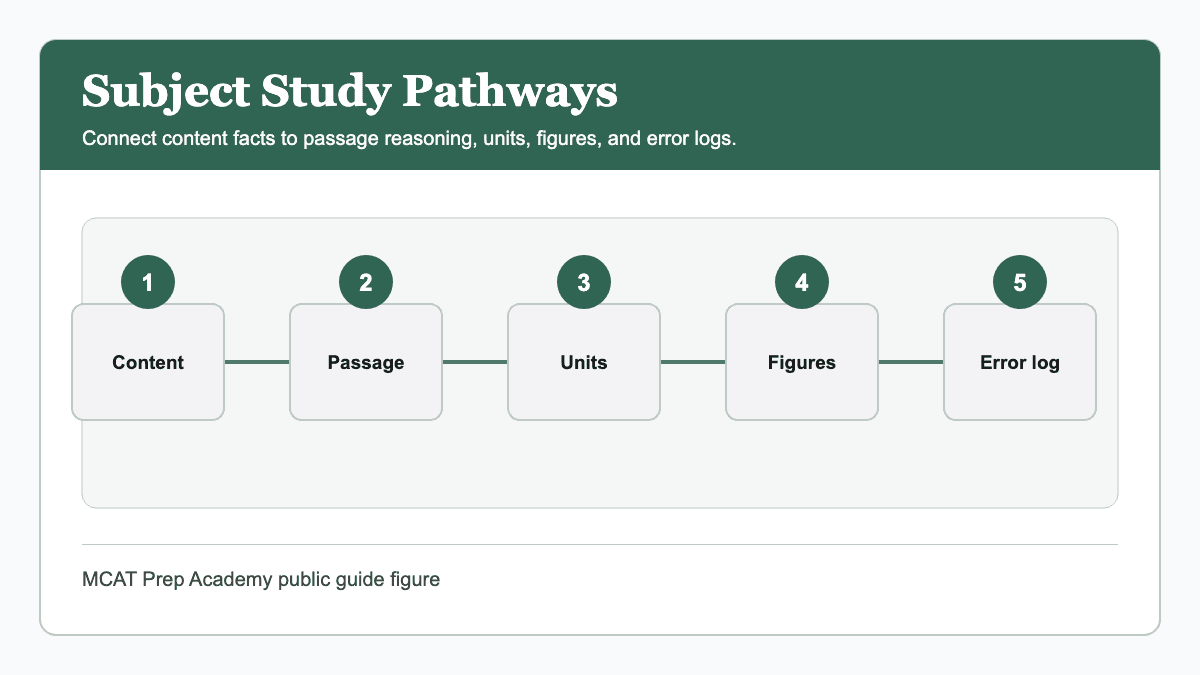
Review equilibrium, acids and bases, electrochemistry, and thermodynamics through units and proportional reasoning.
Use official AAMC topic scope for coverage and check each equation against units, assumptions, and passage context.
Build the atom from protons, neutrons, and electrons, then learn to read isotope notation and weighted atomic mass without getting tripped up.
8 min read
A first-principles walk through Niels Bohr's quantized atom and the line spectra it predicts, including the math you actually need for test day.
9 min read
A working model of the four quantum numbers, orbital shapes, and the filling rules that determine where every electron sits.
11 min read
A working guide to Aufbau, Hund, and Pauli with the diagonal filling order, the chromium and copper exceptions explained from first principles, and ion configurations done right.
10 min read
The periodic table encodes electron configuration, effective nuclear charge, and the trends in radius, ionization energy, and electronegativity you need on test day.
11 min read
How effective nuclear charge and shell distance jointly govern atomic size and the energy cost of stripping an electron.
9 min read
Electronegativity and electron affinity both measure an atom's pull on electrons, but in different contexts — bonded vs. gas-phase — and the exceptions to each trend reveal more about orbital structure than the trends themselves.
9 min read
How shielding by core electrons shapes the net pull an outer electron feels, and why that single quantity explains nearly every periodic trend on the exam.
9 min read