High-yield review
Group mechanisms by electron flow, stability, stereochemistry, and spectroscopy clues instead of isolated reactions.
MCAT subject hub
Public organic chemistry overview for mechanisms, spectroscopy, stereochemistry, and functional groups.
Organic chemistry is a pattern-recognition section: electron flow, stability, and structure explain most answers. Use this page as a public overview. Full lesson flows, quizzes, and account progress stay inside the private app, while these edited guide links give crawlers and students enough context to understand the topic area before signup.
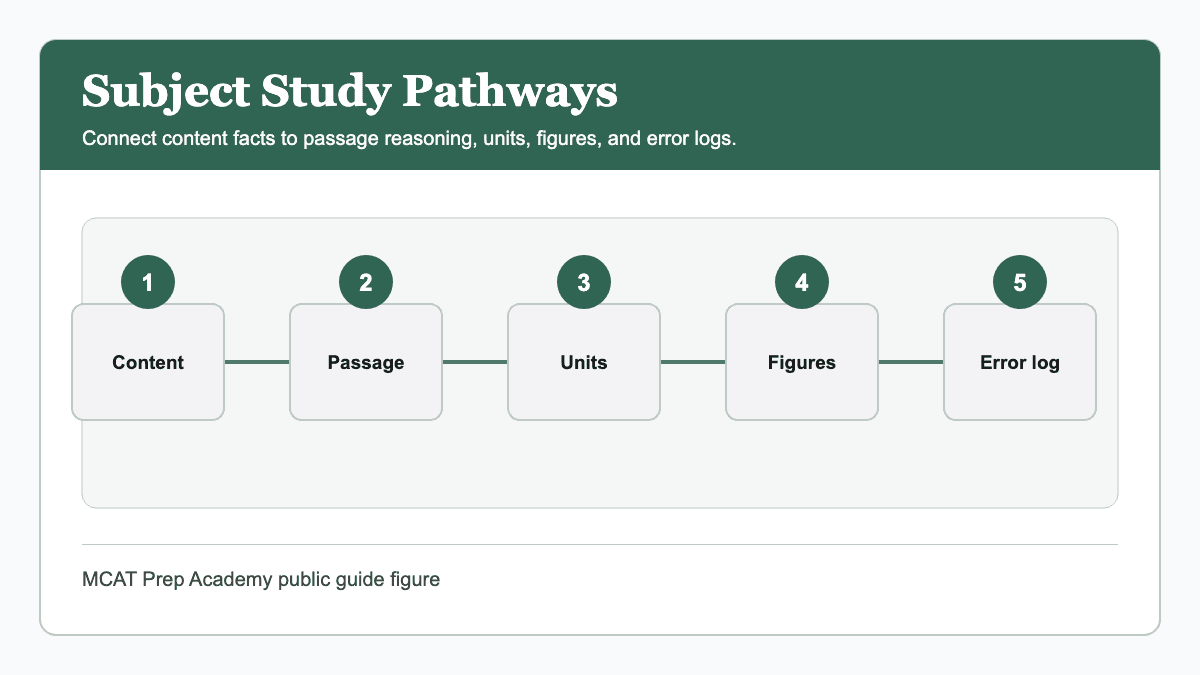
Group mechanisms by electron flow, stability, stereochemistry, and spectroscopy clues instead of isolated reactions.
Treat mechanism patterns as reasoning tools and verify coverage against official AAMC content categories.
Build the valence-shell logic that drives every organic mechanism, from electron counting through hybridization to bond geometry.
7 min read
Sigma and pi bonds explain rotation, geometry, and reactivity across every organic structure you'll meet on test day.
8 min read
Carbon picks sp³, sp², or sp based on steric number, and that choice sets geometry, bond angles, and how many pi bonds the atom can form.
9 min read
A working model of bonding and antibonding orbitals, frontier orbital reasoning, and how conjugation shrinks the HOMO–LUMO gap on the MCAT.
8 min read
How bond order, bond length, bond energy, and s-character interlock — and how to predict any of them from a Lewis structure on test day.
7 min read
Master the rules for drawing valid resonance structures, ranking contributors, and predicting where charge actually lives in a molecule.
9 min read
How spreading electrons over multiple atoms lowers energy, and how to spot the stable species on test day.
9 min read
Master formal charge calculation, the neutral valence patterns, and how to use formal charge to rank resonance contributors on test day.
9 min read